
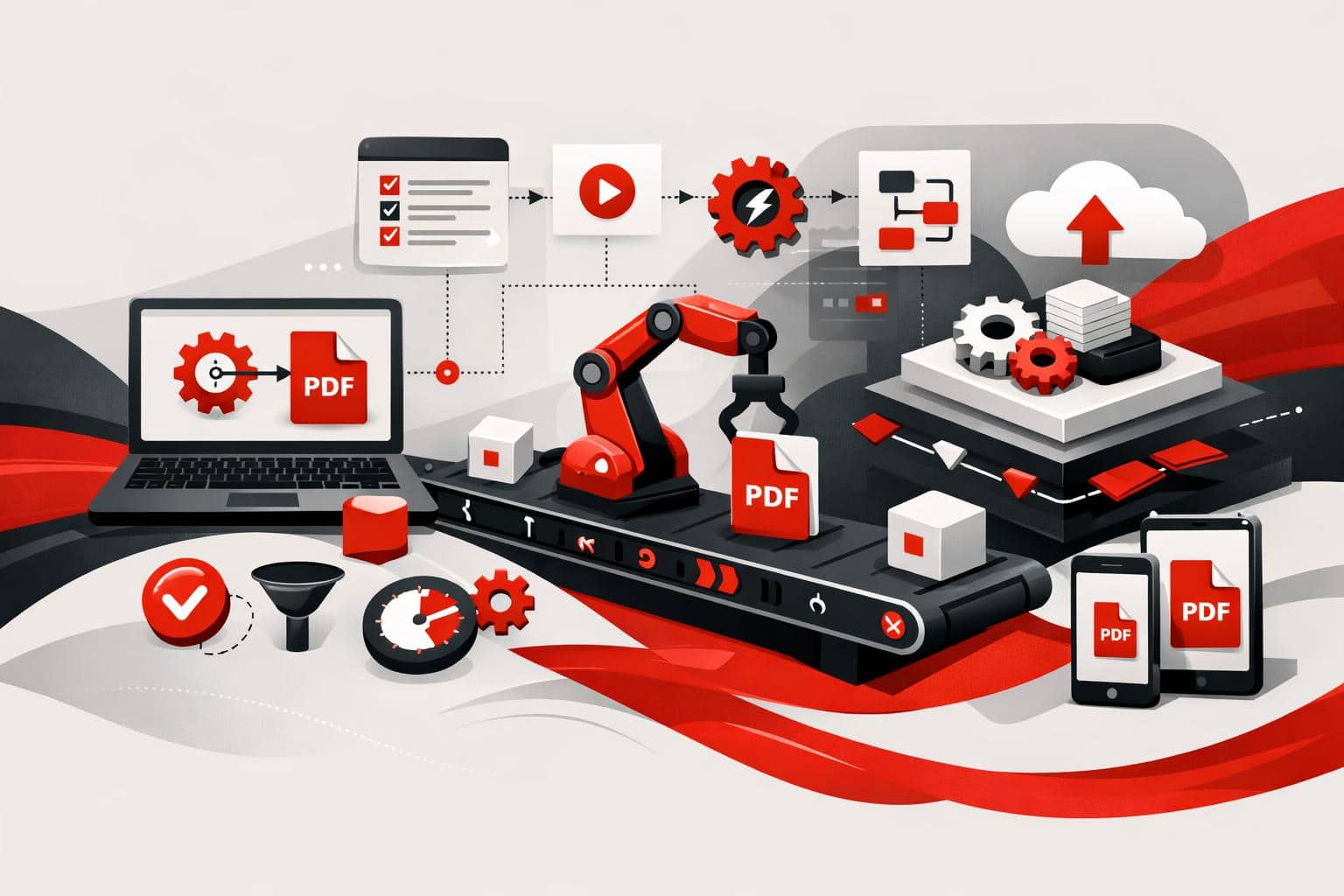
iLovePDF is pushing document work beyond manual uploads by offering two automation routes, no-code connectors for teams that want fast workflow wins, and iLoveAPI for developers who need PDF, image, and signature features inside their own software.
What changes when documents run themselves
Most PDF work is not intellectually difficult. It is repetitive, fragmented, and expensive in small increments. Compressing invoices, merging contract attachments, converting files, resizing images, requesting signatures, and filing the result are classic workflow tax.
Automation removes the human from the click path. A trigger starts the job, such as a new email attachment, an approved quote, or an uploaded product image, then the workflow runs the required document steps without another manual action.
The market now splits into a simple three-part model: connect for no-code workflow automation, embed for API-driven product features, and interpret for AI-ready document intelligence. iLovePDF now has a position in all three layers through iLovePDF, iLoveSign, iLoveIMG, and iLoveAPI.
No-code automation for everyday file work
No-code is the fastest path when the goal is to connect the tools a team already uses. Platforms such as Zapier, Make, Microsoft Power Automate, and n8n can trigger iLovePDF, iLoveSign, and iLoveIMG actions from common business events. The iLoveAPI integrations page lists connectors for PDF, image, and e-signature workflows.
A practical example is an accounts payable inbox. When a supplier sends a large PDF invoice, the workflow can compress the file, rename it with the supplier name and date, save it to the correct cloud folder, and notify finance in chat. The employee reviews the invoice, not the file handling.
The same logic applies to sales and marketing. A signed proposal can be merged with a statement of work and archived, while a new batch of product photos can be resized and optimized before reaching an online store. The value is cumulative, because ten small automations can remove hundreds of low-value clicks each week.
- Compress: Reduce large PDFs as soon as they arrive.
- Sign: Send approved documents into an e-signature flow.
- Convert: Turn PDFs, images, or office files into the required format.
- File: Move finished documents into the right folder or record.
Odoo brings document tasks into the record
The new Odoo connectors matter because ERP work loses momentum when users jump between tabs. Odoo often holds the customer, invoice, quote, contract, or HR record, so the document action should happen there as well.
The iLovePDF connector for Odoo brings PDF compression into Odoo Documents, including bulk compression and file size insights. That keeps attachments smaller without pulling users away from the business record they are already handling.
For sales, that means a quote can move toward signature from the opportunity context. For finance, it means bulky attachments can be compressed before storage or sharing. For legal and operations, it reduces the risky habit of downloading sensitive files, processing them elsewhere, then re-uploading the result.
The API route for product teams
No-code solves routine operations. The API solves product integration. iLoveAPI exposes PDF, image, and signature capabilities through a REST API, so developers can build document processing directly into internal platforms, SaaS products, customer portals, and backend pipelines.
The official API reference describes a task flow built around starting a job, uploading files, processing them, and downloading the result. The same documentation lists supported PDF tools such as merge, split, compress, protect, OCR, watermark, office conversion, and PDF to Markdown.
Five AI tools expand the workflow
The newer AI tools move iLoveAPI from file manipulation toward document understanding. Summarize can condense long documents, PDF Forms can detect or fill fields, Smart Split can separate bundled documents by content, PDF to Markdown can produce structured text for websites and AI systems, and Translate can make document content usable across languages.
That shift is important because modern document pipelines often feed search indexes, language models, compliance systems, or customer dashboards. A PDF that becomes clean Markdown, a short summary, and structured form data is no longer just a file. It becomes usable business input.
Python support lowers the developer barrier
The API now supports Python alongside PHP, .NET, Ruby, and Node.js. The official iLovePDF GitHub organization includes libraries and examples, and the Python library covers automation tasks such as compression, merging, splitting, conversion, protection, and PDF to Markdown.
That matters for AI and data teams, because Python is the default language in many document intelligence stacks. Developers can prototype a document pipeline in the same language they use for data extraction, evaluation, and model orchestration.
How to choose the right path
The decision rule is simple: choose no-code when the workflow connects existing apps, choose the API when the document feature must live inside software. If a finance manager can describe the process as “when this happens, do that,” no-code is usually enough. If a developer needs authentication, custom logic, volume handling, or native user experience, the API is the cleaner foundation.
| Route | Best fit | Typical user | Main advantage |
|---|---|---|---|
| No-code connectors | Automating repeated tasks across existing apps | Operations, finance, marketing, sales | Fast setup without developer time |
| Odoo connectors | Compressing and signing documents inside ERP records | Teams that work mainly in Odoo | Less switching between systems |
| REST API | Embedding document tools into products or internal platforms | Developers and product teams | Greater control, scale, and native integration |
| AI document tools | Preparing documents for models, search, summaries, and data extraction | Data, AI, and automation teams | Turns static files into structured workflow inputs |
A sensible rollout starts with the tasks that hurt most often. Automate inbound compression, signature routing, contract archiving, image optimization, and PDF to Markdown conversion first. Move only the high-volume or product-critical workflows into the API after the pattern is proven.
Security and next steps
Automation is only useful if teams can trust the file path. iLovePDF says its file handling uses encryption, GDPR-oriented controls, and ISO 27001 certification, and its security overview explains how uploaded files are protected during processing. More detail is available on the company’s file safety explainer and business page.
The strategic point is not that every document should become an automation project. It is that repeated file handling should stop competing with actual work. Start with no-code for quick operational relief, keep Odoo work inside Odoo where possible, and use iLoveAPI when document processing needs to become part of the product itself.